Last September I wrote this piece (“Sports Channels and Smoking, an Analogy”) about cancelling all my sports subscriptions in the summer. I had already watched a few football matches in pubs but had spent less money on beer than I would have spent subscribing to the relevant channels. And I had saved plenty of time. This continues to be the case, exactly four months later. I have not relented and reactivated any of my subscriptions, even for the Ashes series that has just ended. (That’s the England cricket team playing a five-match Test Series in Australia, for those of you who do not follow such things.) Based on the result (a 4-1 win to Australia) and the hapless nature of much of the batting I am especially glad that I did not spend much time or any money on these fixtures.
Regarding the team I have supported since childhood (Leeds United) I have been selective about the games that I watch in pubs. I missed every minute of the 2-1 defeat at home to Spurs on Saturday 4 October but did catch all of the 2-1 home win against West Ham on Friday 24 October, an evening out with my son and his godfather (a West Ham fan). We enjoyed the game rather more than he did, but there was a reggae band playing in the bar upstairs afterwards to lift his spirits. I didn’t watch either of the fixtures that were broadcast in November (a 2-1 defeat at home to Aston Villa and a 3-1 loss at Nottingham Forest). The only game I watched all the way through in December was the 1-1 draw at Sunderland on Sunday 28th. My children joined me at the nearby Irish pub for the second half, just after Leeds had equalized. As the game progressed I was keeping track of all the different nationalities that played at least part of the game for Leeds. Including substitutes there were 11. I wasn’t sure whether this had happened before. In the 1970s, as with most English teams, the entire squad came from the four Home Nations and the Republic of Ireland, although I’m struggling to think of any Northern Ireland players before John McLelland (1989-92).
I tore a piece of paper out of my A6 Notepad and started writing nationalities and names of Leeds players. By the end of the match it read:
Brazil Perri
Sweden Gudmundsson
Netherlands Struijk
Slovenia Bijol
England Bogle
Wales Ampadu
Japan Tanaka
USA Aaronson
Italy Gnonto
Germany Stach
Switzerland Okafur [I misspelt it, Okafor is the correct spelling.]
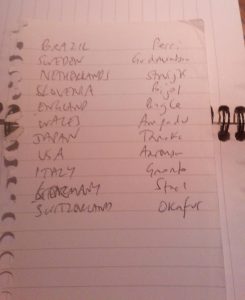
Nine of those players started the game. Tanaka came on for Rodon (Wales) in the first half. Gnonto came on for Calvert-Lewin (England). Okafor was replaced by Nmecha (Germany).
In addition there were unused substitutes from two more nationalities: Bulgaria (Gruev) and Belgium (Bornauw).
For all I know this may be a regular occurrence in the Premier League, teams fielding at least 11 different nationalities in the same game. I found it noteworthy, especially as Scotland was not one of the nationalities represented. The current Leeds team is the only one in my lifetime that has won anything, or been promoted to the top division, without being captained by a Scotsman. Bobby Collins, Billy Bremner, Gordon Strachan and Liam Cooper all played for Scotland and all captained Leeds in their trophy-winning seasons or when they were promoted to the top tier. Bremner and Strachan (red-headed Scotsmen) are the only Leeds captains to have won trophies at the top level. When the club signed David Hopkin (another red-headed Scot) in 1997 a few of us speculated that they were trying to repeat the trick. It didn’t work.
Before drafting this piece I didn’t realize that last Wednesday’s match at Newcastle went even further. I chose not to leave the house on a bitterly cold January night and followed the action on Radio 5 Live instead (a 4-3 defeat, and Leeds were leading 3-2 after 90 minutes). I see from the BBC website that this was the starting lineup (I have added the nationalities and kept the squad numbers):
1 Lucas Perri (Brazil)
5 Struijk (Netherlands)
15 Bijol (Slovenia)
6 Rodon (Wales), substituted for Bornauw (Belgium) at 97 minutes
4 Ampadu (Wales)
3 Gudmundsson (Sweden)
24 Justin (England)
44 Gruev (Bulgaria), substituted for Tanaka (Japan) at 97 minutes
18 Stach (Germany), substituted for Okafor (Switzerland) at 80 minutes
11 Aaronson (USA), substituted for Gnonto (Italy) at 97 minutes
9 Calvert-Lewin (England), Striker, substituted for Nmecha (Germany) at 87 minutes
Or, if you prefer, here is the same basic information with the nationalities listed first:
Brazil (Lucas Perri)
Netherlands (Struijk)
Slovenia (Bijol)
Wales (Rodon, Ampadu)
Belgium (Bornauw)
Sweden (Gudmundsson)
England (Justin, Calvert-Lewin)
Bulgaria (Gruev)
Japan (Tanaka)
Germany (Stach, Nmecha)
Switzerland (Okafor)
USA (Aaronson)
Italy (Gnonto)
13 different nationalities playing for one club, in one match. I think this is a record for Leeds United. Can any other clubs beat it?
 The Compartments